Staccato -> Drone
-migration fades to invisibility-

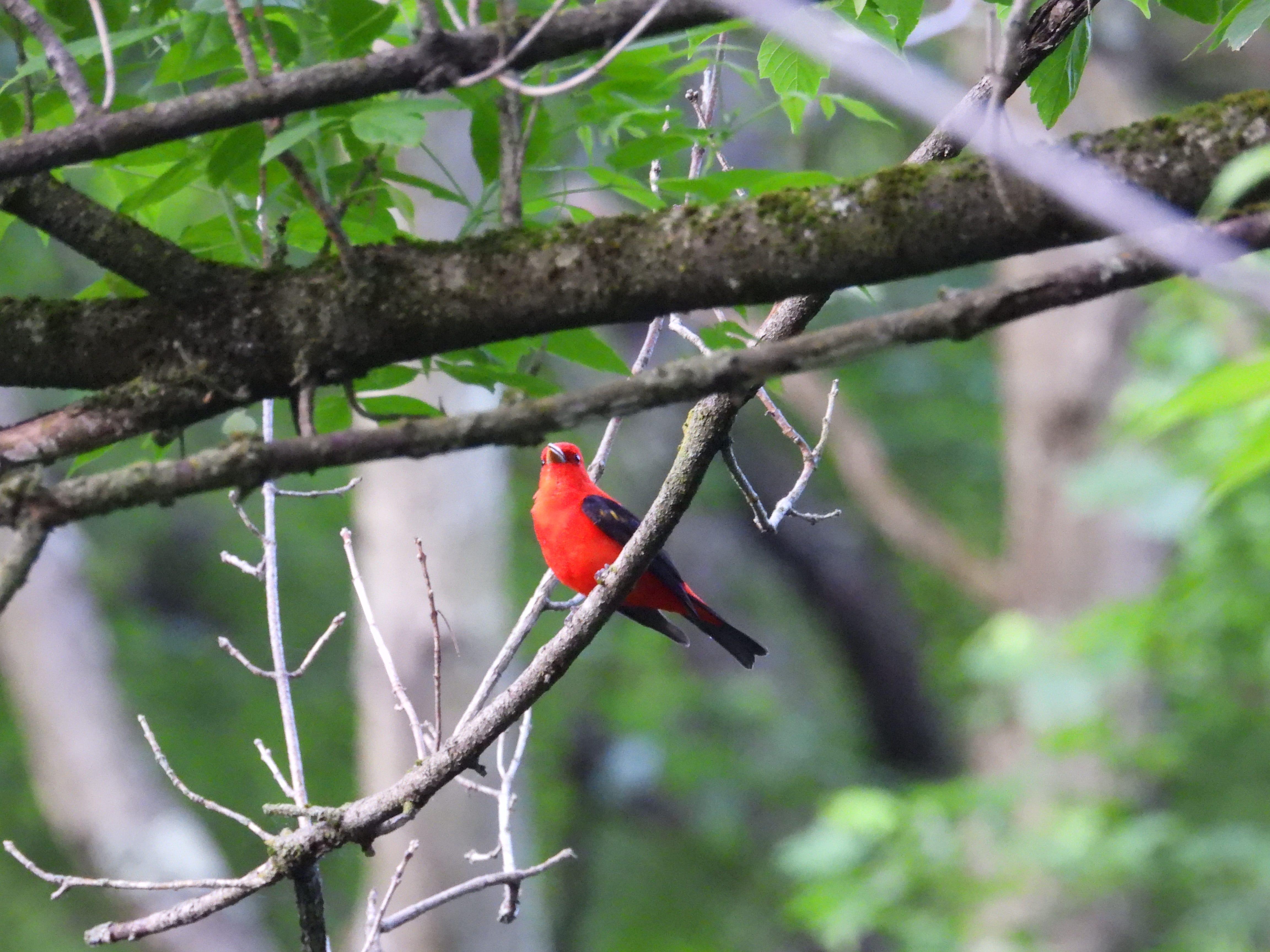
On Sunday, May 17, it’s already 61 degrees at 5 AM, and night movers continue to number in the millions. Even in town, there’s the sour smell of sewage from the other side of the Gap on an unusual easterly. By 5:07, on the slopes above the tracks, Scarlet Tanagers are starting up. A Killdeer flies low overhead, crying, toward town. Activated like everything else in the new warmth, spiders have closed in the narrow passage up the first part of the knife-edge, covering me in silk.
The woods are still dominated by myriad vocalizations of female and male American Redstarts above all else, though with a larger proportion of breeders and fewer passersby; perhaps the available territories are finally used up. I have to wonder if the sharp rise in redstarts is somehow related to the noticeable dip in Cerulean Warblers this year.
As the canopy fills in with leaves and green bursts out at every level, the towering forest along Grosbeak Trail looks more and more like the tropical rain forests the new arrivals spend most of their year in. A decent number of Eastern Wood-Pewees and Acadian Flycatchers, the last arriving breeders, are about. A Canada Warbler sings insistently in one of the steepest ravines, but it definitely won’t breed here at our low elevations. Farther along, in the usual witch hazel understory, an unseen Yellow-bellied Flycatcher calls, one of a trickle that spend brief periods here before arriving to northern bogs. Meanwhile, White-throated Sparrows and Ruby-crowned Kinglets are noticeably absent, part of the massive decline in overall numbers during the second half of May.


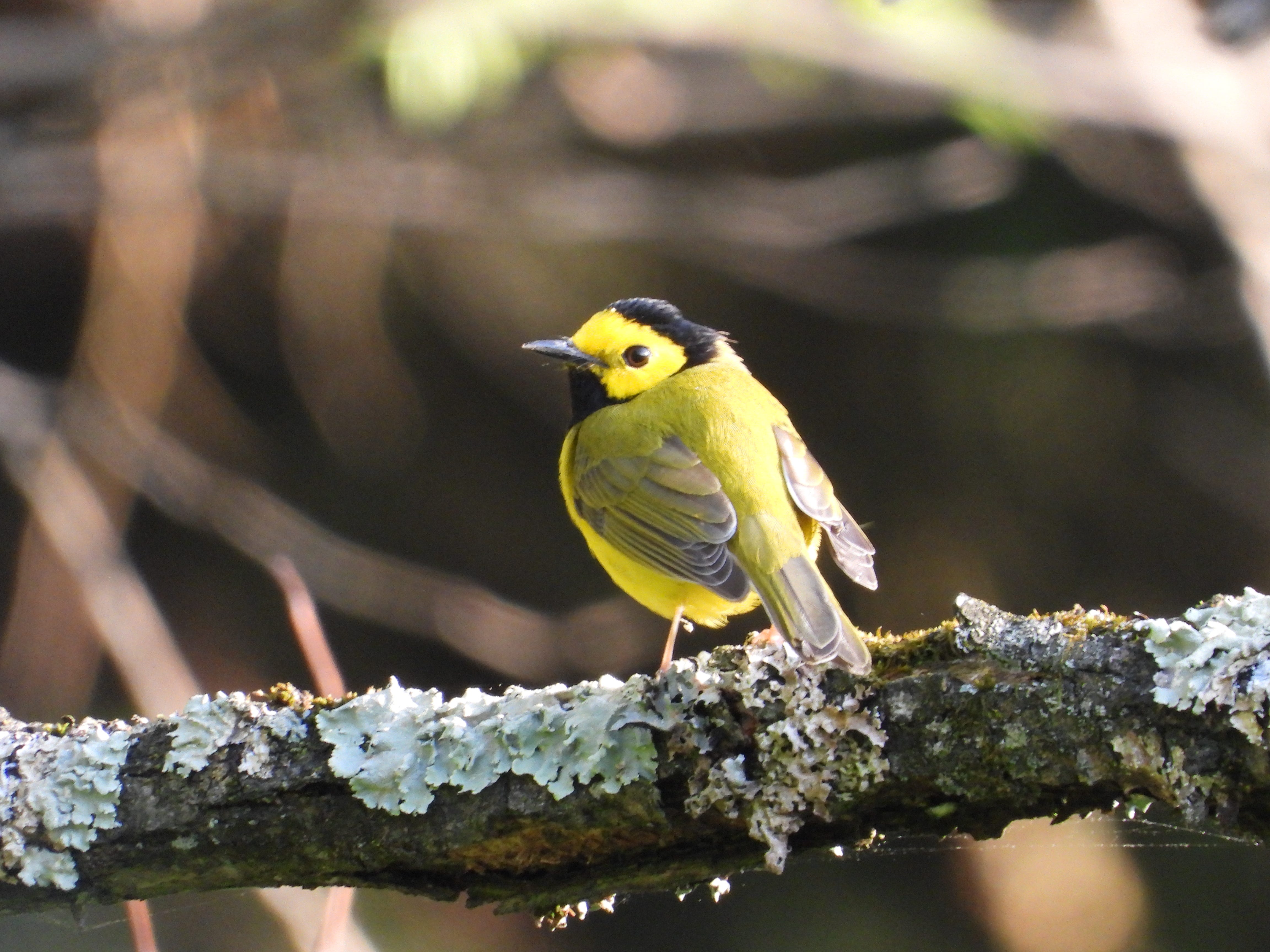
The Kentucky Warbler is singing less now, but he’s still around in the same spot, so I think breeding remains a strong possibility. Last year, one (perhaps the same?) only stuck around a few days before leaving, but this one’s been here since the beginning of the month.
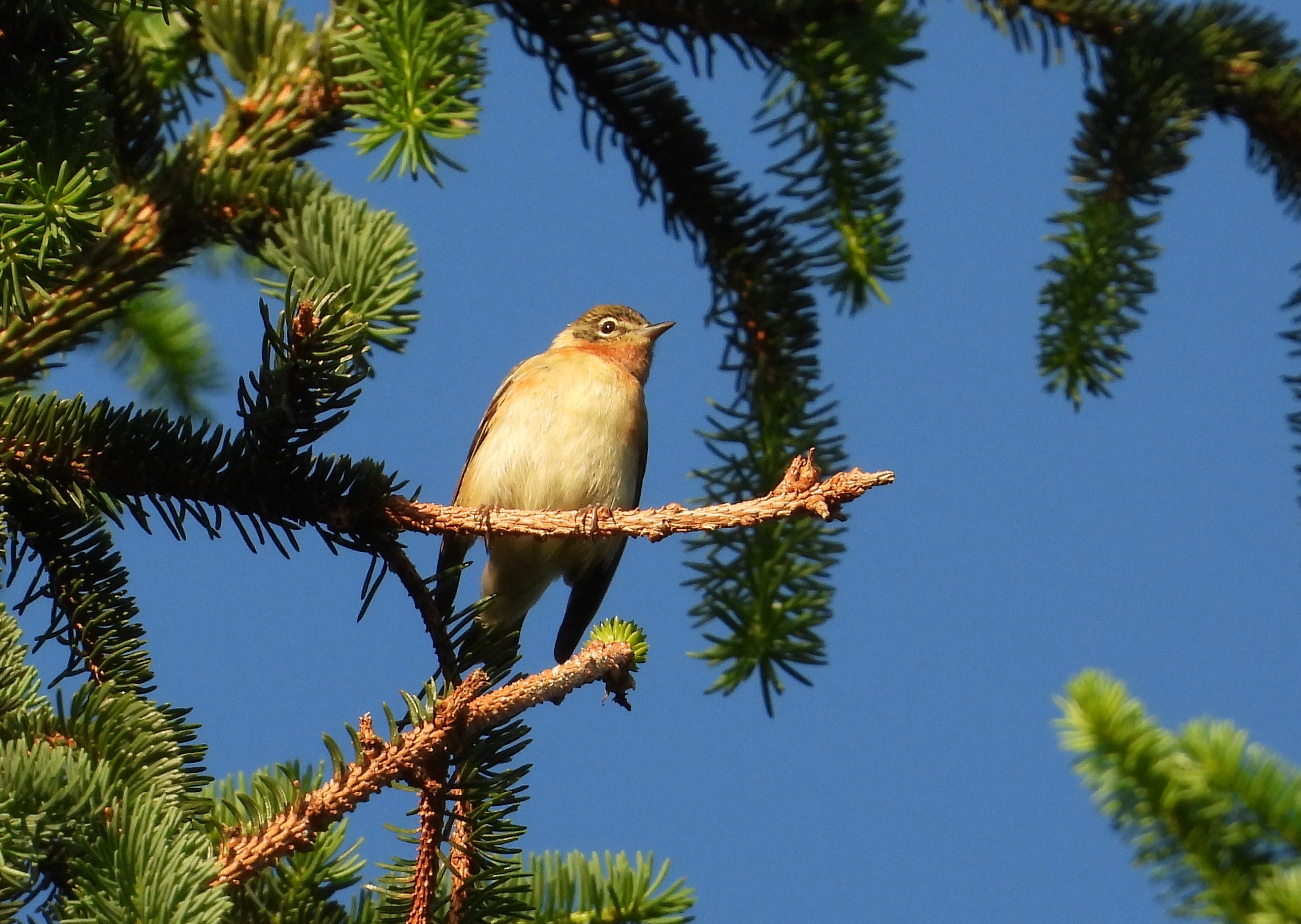
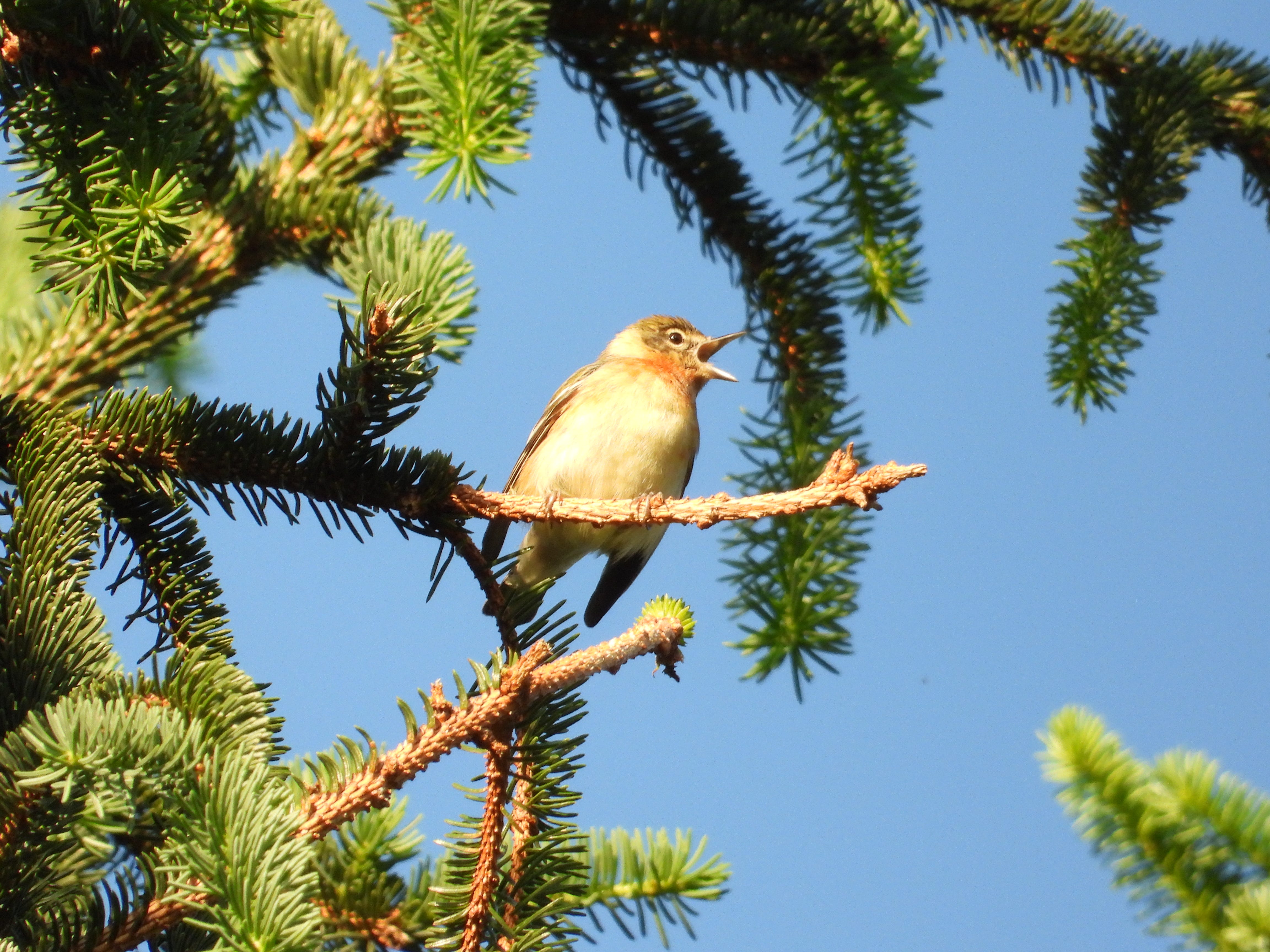
At the spruce grove, I intersect a large wave of late-season warblers on the move toward the taiga; they’re dominated by Bay-breasted Warblers in the dozens, including a female who pops out to sing. Among the locusts, Least Flycatchers, part of a big push this year, are chebec-ing non-stop.
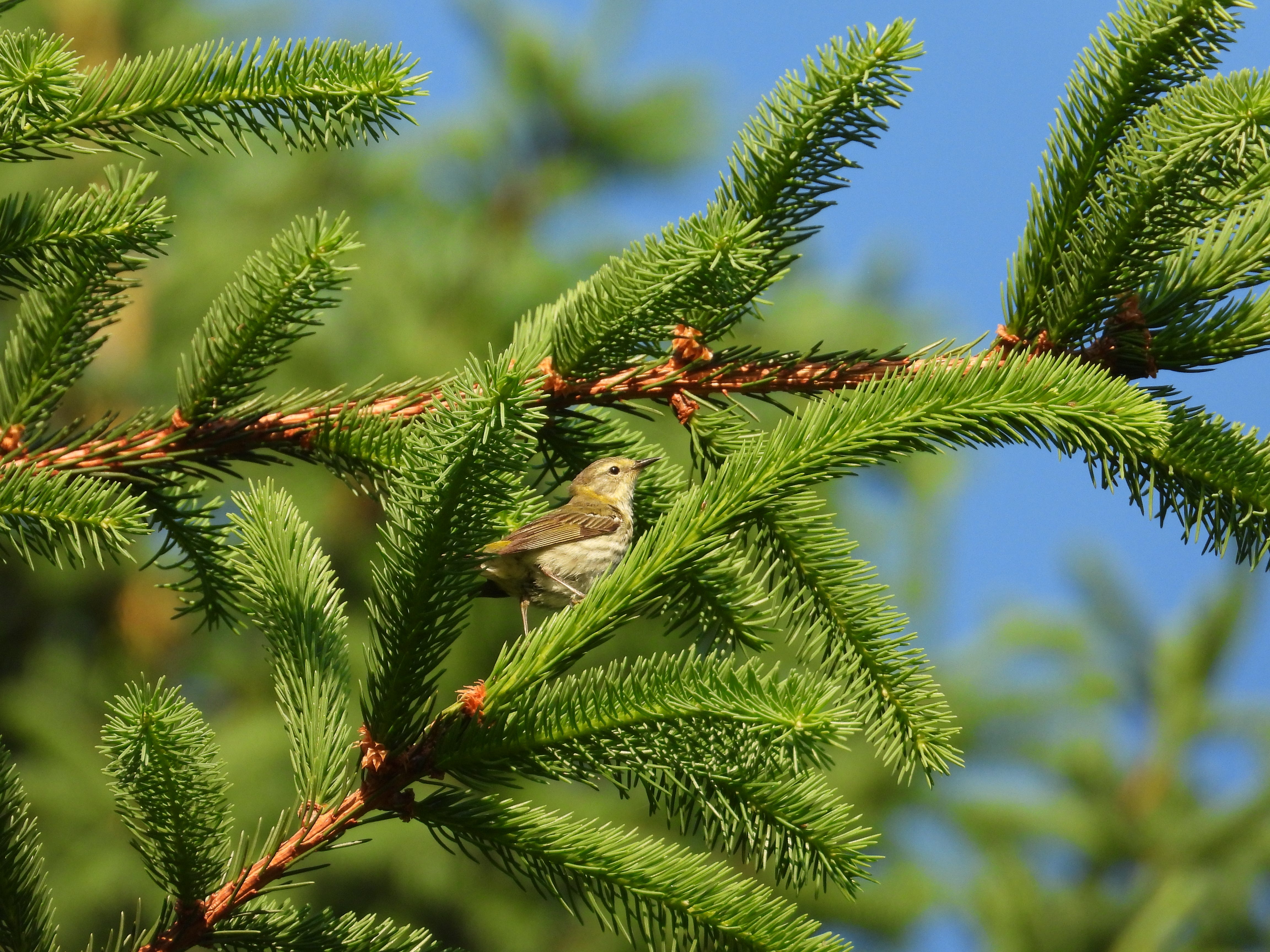
Oddly, though I can also hear the soft staccato of Blackpoll Warblers, not a single one is visible, even while Hooded, Magnolia, Tennessee, Blackburnian, Cape May, Black-throated Blue, and others are obvious and nearly tame. In the background, down where the black locusts meet the thicker deciduous woods on Sapsucker Ridge, a Mourning Warbler sings. I text Connor, a local birder who’s been at this for just a couple years, and he arrives not long after I’m gone, happily adding the species to his life list. Mourning, along with Kentucky and Connecticut warblers, Philadelphia Vireo, and Yellow-bellied Flycatcher, are Plummer’s Hollow specialties of sorts, easier to see, or at least hear, in our hotspot than in most places. Or, at least, that seems to be the reason we’ve been somewhat inundated by local birders this May (dozens, in any case).
Hawking
Prelude to a heatwave, the evening sky off the balcony is clouded with bugs. It doesn’t quite hit me what is going on until I watch a Chimney Swift double back in mid-hurdle to snap at something. I’m not quite sure how the sudden deceleration needed for the tight S-curve works in terms of basic physics, but as I’ve seen swifts fly about in lightning storms, I figure anything’s possible. Less spectacularly, ungainly European Starlings are hawking like swallows, gulping down anything they can grab, bobbing and floating about all over the sky. A resident Eastern Phoebe positions itself on a high twig and launches itself nearly straight up, again and again, typical behavior for a flycatcher. A bit odder is similar behavior from a female House Sparrow, and then from a Blue Jay.
To the north, the sunlit sky is dotted with swifts and local Turkey Vultures; among the swifts, a Common Nighthawk also flops about in the midst of the feast. A Green Heron lifts up silently from the creek behind the row of sheds in front of me, barely clearing the balcony. As dusk approaches, a pair of Common Mergansers, likely nesting close by, heads through the Gap—a rare sighting this time of year.
And then, a Blackpoll again, gentle staccato, ts-ts-ts-ts-ts-ts, invisible, somewhere in the dense growth along the river, not more than a dozen yards from me.
Five million+
When I get a chance to go over the tape, the warm-up turns out to have predictably coincided with a rush of species: Friday night was strange shorebirds like the first Short-billed Dowitchers in a couple years, and the rasp of a Caspian Tern. Saturday night, unsurprisingly considering what I found Sunday morning, was mostly warblers.
Monday morning, 4,857,800 birds have transited Blair County, heading northeast, by 4 AM, as the final descent begins. The BirdCast total reaches just over 5 million individuals before it’s over with. The peak was at 11:30 PM, with a mind-boggling 477,000 in flight at one time over the county. I drive up to save time, reaching the garage by 4:30, a few minutes in advances of the chorus. Some quick calculations based on bird direction and the width of the hotspot: I think we got about 100,000 going over, many low enough to be heard, though of course numerous species do not vocalize in flight. I’ll see the tape later; in the mean time…
By 5 AM, with the temperature at 60 and muggy (heading toward 90), 12 species are already detectable. A local Yellow-billed Cuckoo sets off a Black-billed Cuckoo; Field Sparrows, Common Yellowthroats, and Gray Catbirds grow louder and louder; a Common Raven screams once. Both an Ovenbird and a Scarlet Tanager emit nightsongs from the nearby woods. Eastern Towhee, then Tree Swallows from the new nesting pair hunting in the twilight by 5:05. Wood Thrush. An unfortunate clatter from the forsythia next to the garage signals the emergence of a catbird so loud it starts to drown out the rest of the chorus.
Finally, at the late hour of 5:18 AM, the local Eastern Whip-poor-will lets loose, moving close around the yards, inundating everything else. Species # 18.
I start a limited saunter around the closest field and woods edge, passing through pockets of warmer air and an odd perfume smell from some distant factory or laundromat. New species chime in quickly, and by 6 AM, with the sun already on the treetops, the list stands at 51 with the addition of a Tennessee Warbler. I believe this is the first time I’ve ever been able to detect 50+ this early.
Back at home, I rush through the night’s tape before work, and it’s just as I thought: some 80% or more of the vocalizations are Swainson’s Thrushes. Had I been standing in the spruce grove rather than in the field, I would no doubt have heard several, as they, along with a scattering of Gray-cheeked Thrushes, another late Amazon arrival (the jungle, not the corp), prefer to bed down there during spring passage (along with Veeries and Hermit Thrushes, both much diminished but still on the move, and the ever-present Wood Thrushes). I’ve no time to count, but I estimate some 80,000 Swainson’s passed over, of which upwards of 5,000 are probably on the tape. A few dozen, minimum, will spend a day or two in the hotspot. This was the first really big (probably the biggest) SWTH day of the spring, and they’ll likely be the only migrant to make it past June 10th, the last of all, long after everything else.
The tape shows blessedly few redstarts, more Short-billed Dowitchers, another Least Bittern, that most cryptic of migrants, and even a clear Great-crested Flycatcher song. So far this year, crystal-clear flight songs of all the flycatchers have showed up, except for the apparently mute Olive-sided. Willows have been particularly in evidence.
Swallow hunt
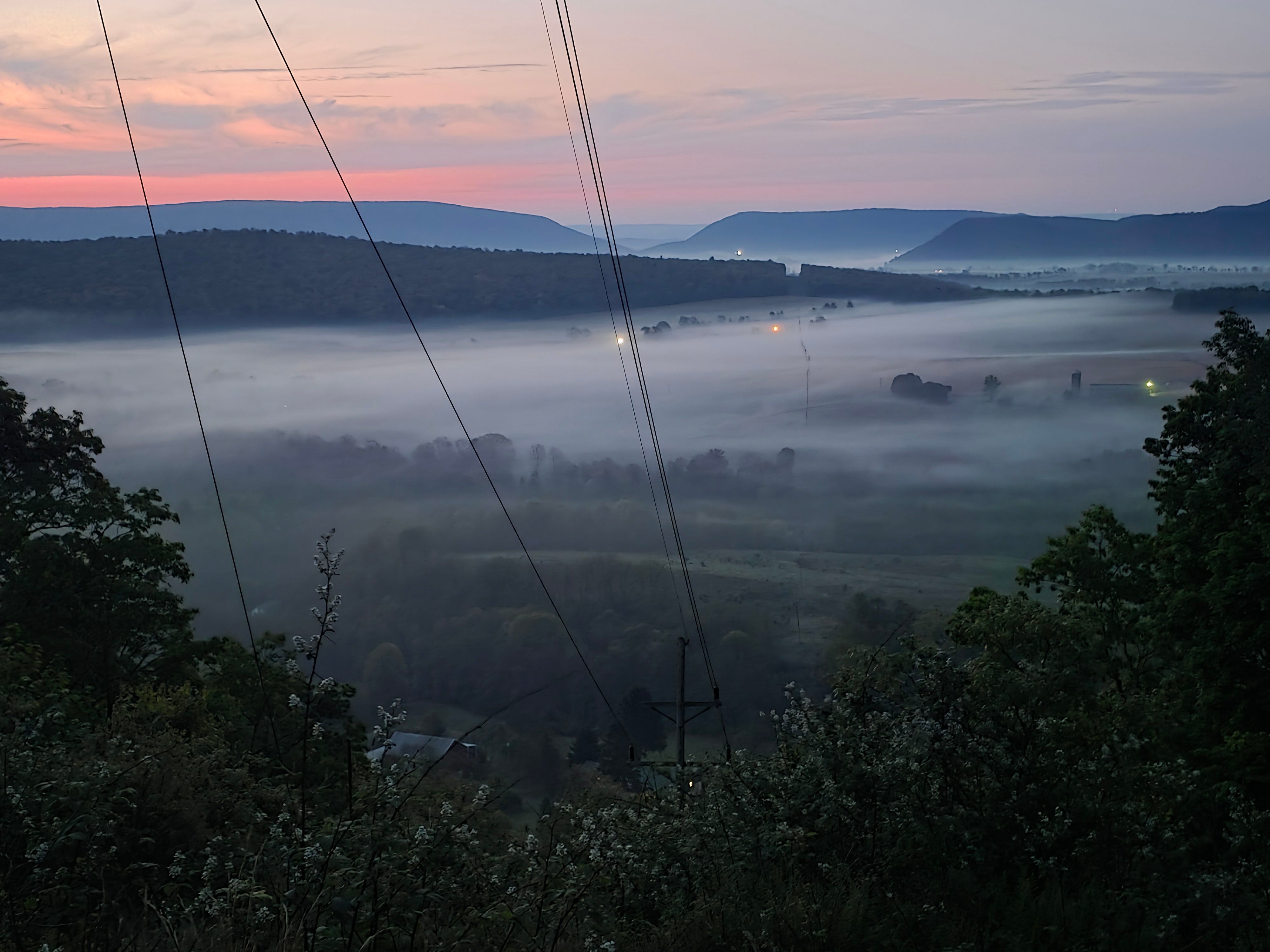
The next day, with the heatwave still on, I start at the powerline in hopes of a chat (no luck). It’s in the 60s and breezy, with patchy fog in the valley, and a couple whip-poor-wills calling. A few more millions went over last night, and it’s not hard to guess what most of them were. At least one Eastern Screech-Owl trills; this species is more in evidence than the Great Horned, which disappears almost entirely in May. Barred Owls, meanwhile, caterwaul from both the spruce grove and the Greenbriar Trail area—we have healthy families in both locations this year, and multiple sightings of owlets.
At 4:30 AM on the 20th, coming back from the gym, I hear but barely see Northern Rough-winged Swallows chirping brokenly as they hunt up and under the street lights. When I look at the tape later, I find that a loud Barn Swallow was hunting in the field near the garage at the same time, along with the first Purple Martins from Sinking Valley up for breakfast, and the local Tree Swallow. These expert bug hunters seem to know exactly where to go and choose the best hours to do so; by daylight, the Barn and the martins are long gone.
After hearing a loud Yellow-throated Warbler recently across from the gate, a ptential breeder (no dice, for the umpteenth year), I do a quick walk along the railroad ROW in what remains of the heatwave. Around 6 AM, I spot a pair of Canada Geese standing nervously in the river, as a flock of 19 coasts loudly overhead, more of those May bachelors. No Yellow-throated Warbler, but the consolation prize is a Northern Waterthrush, another lingering late-May species that almost certainly won’t try to breed here.
And then the heavens open and the heatwave draws to a rapid conclusion. Days of cool and rain await as the southerly flow is choked off entirely, allowing at best a tiny trickle of migrants to move. Most of the unusual species over the next week will likely be local arrivals in search of better territories.
Sometime in the afternoon, Pepe and I watch an adult Bald Eagle spiral down from the storm clouds as the rain becomes too much. It seems to want to land in the parking lot but opts for the confluence beach instead, just out of sight.
Blackpolled
The next day, rainy and cool, I hear that familiar staccato again, as I’ve been hearing it every day from the balcony. This time it comes from a small, avenue-side pear tree just outside my office window, but still I can’t see the bird. Throughout the day, in front and back along the river, it goes on and on as it waits for the next south wind.
A few things make it through, like a late American Bittern at 9:33 PM, not long after an presumably local American Woodcock, unheard since April, finally calls again in the field, signaling, I would guess, that a new stage of its life cycle has begun (second brood?). At 10:18 PM, a Semipalmated Plover flock, forced low due to the rainy weather, goes over. It takes a full minute, with individuals close by and others farther away; I’d guess the flock contains dozens or even hundreds of them:
At 4 AM, an American Robin plants itself square in the middle of an empty Pennsylvania Avenue, singing its heart out.
Bottled up
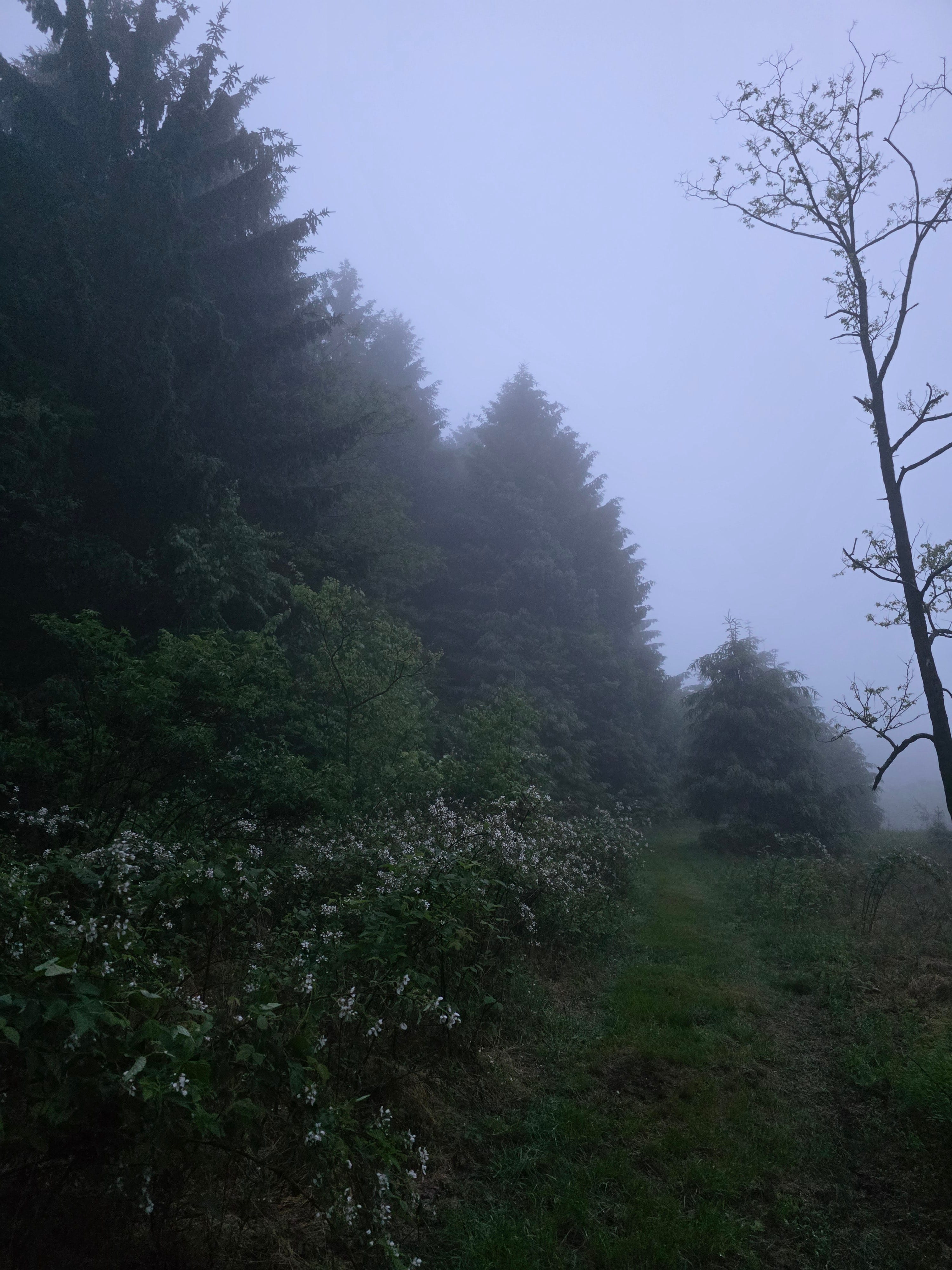
Saturday the 23rd brings heavy rain, but Sunday clears enough to allow an early hike up top. The first sound, a Song Sparrow, doesn’t register until 4:56 AM due to the heavy cloud cover and spitting rain. A light flight of some 29,000 birds over the county last night dictates a certain late-month desperation to get on territory, and there’s an off chance the handful of missing Plummer’s Hollow species might be on the tape or in the woods somewhere.
Birds are bottled up after days of adverse weather. The spruce grove is alive with Magnolia Warblers and Swainson’s Thrushes, and different Mourning Warblers are singing from two points along the upper edge of First Field. Beyond the field’s northern corner, a Kentucky Warbler is singing in the deep woods, a different one from the presumed breeder. Far off down Roseberry Hollow, a Yellow-breasted Chat calls, first and perhaps only of 2026. Back in town, a Ring-billed Gull flies about incongruously among the multi-story brick buildings. Birders heading toward Plummer’s Hollow to search out another Yellow-bellied Flycatcher are delayed by a Whimbrel in a local flooded field, which gives me hope that one might pop up on the tape.
The next morning, Dave’s Merlin picks up a new-to-him song, three-beers: an Olive-sided Flycatcher, last of the expected spring passerines, pausing for a new second atop a snag, maybe one of the decaying black locusts by the house.
The next wave hits during the night of May 26-27 with renewed southerly flow, but now, after a week’s delay, only around a million go over the county, again, mostly Swainson’s Thrushes. A few Green Herons chirp now and then, in a sparse year for them. More Grasshopper Sparrows whisper over, in a banner migration year for them that commenced almost two months ago. A lone nighthawk calls twice at 12:11 AM, some Spotted Sandpipers, always the commonest shorebird, a Savannah Sparrow, a Canada Warbler, and a very nice Willow Flycatcher at 1:54 AM:
The only real indication I have of all this, from my dawn balcony perch, is a once-heard Black-throated Blue Warbler.
Once again, the missing common shorebirds don’t show, so the year list for Plummer’s Hollow stays at 194, #5 for Pennsylvania. May numbers are also good, with 154 species, #6. With all the extra effort for Blair County on the eve of the Pennsylvania Society for Ornithology conference/festival here in a few weeks, we stand at #13 out of 67, not quite where we wanted to be, but way ahead of where we’ve been at any year in the past.
Preachers
Finally, on Wednesday, May 27th, the soft staccato is no longer there. In all that time, I never saw him (her?), and their absence closes the chapter, as it does most years, on the obvious and visible part of the spring migration. Even with a few respectable May nights left, arriving or transient migrants will be more of the same and it won’t be easy to tell anymore if they are locals or passersby.
At 6:24 AM on Wednesday, two local Cooper’s Hawks circle lazily together over downtown and drift off northward, toward the towers, barely evoking any reaction from circling swifts. A few minutes later, a Wood Thrush, of all things, lands in the nearest sycamore and sings once, very loudly. This is the first time I can remember one doing this; they nest close by, but in the deep woods above the interstate.
On Thursday I head up quickly to the spruce grove to see if any migrants are still around, after another birder, Mike, saw a Yellow-bellied Flycatcher here last evening, as well as a Blackpoll Warbler. The only out-of-place bird is a quiet Hermit Thrush under the spruce boughs, which makes me wonder, as I do every year, whether this species breeds here.
The tape shows a new phenomenon: A local Red-eyed Vireo, singing softly all night long for the last several nights. While we of course have night-singing cuckoos, Field Sparrows, Ovenbirds, and several others, they don’t tend to stray into mimic territory and go on non-stop (chats, catbirds, and mockingbirds also are known to go all night). For whatever reason, this vireo, perhaps unsuccessful at finding a mate in the day, has insomnia.
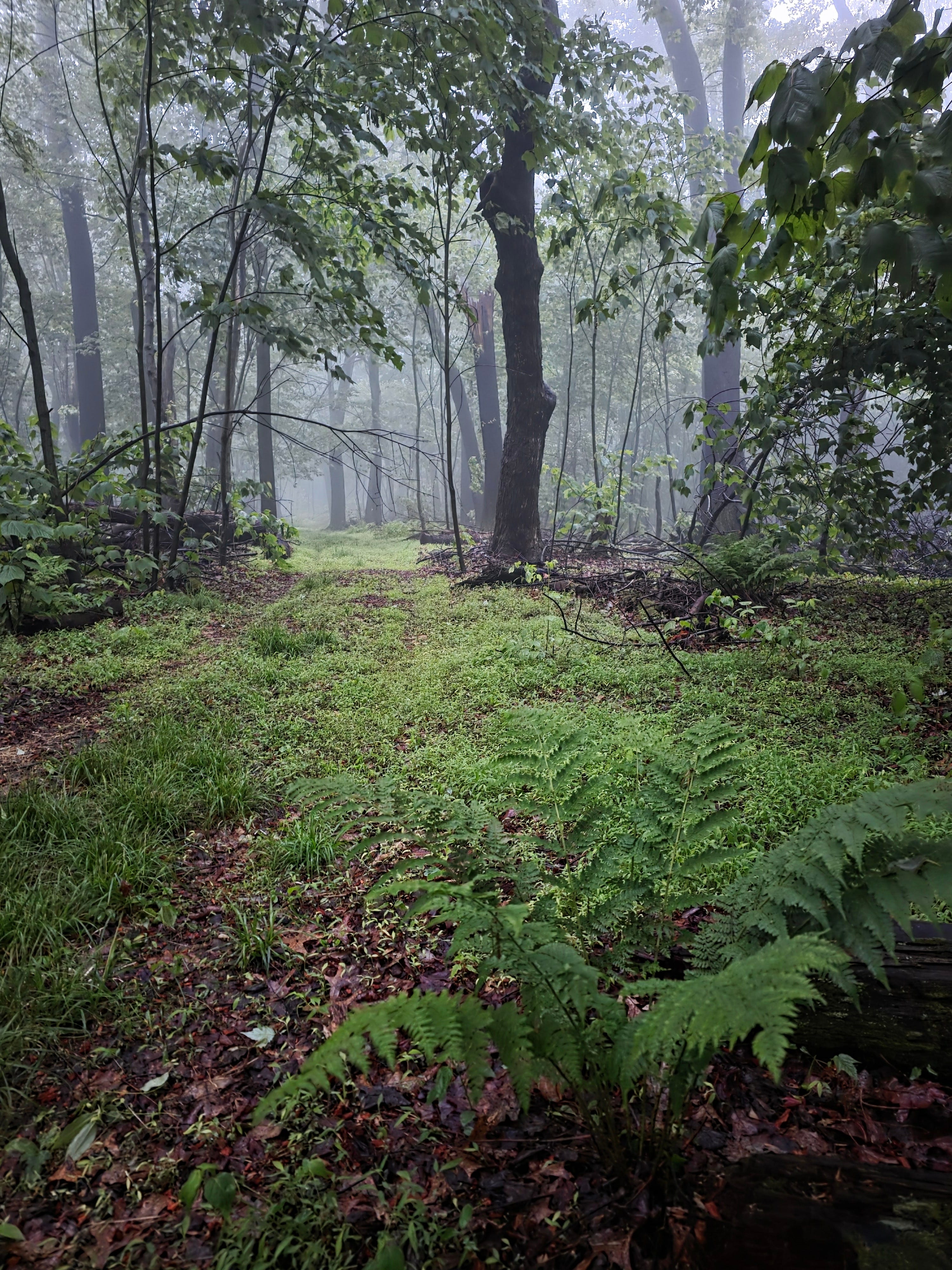
During the day, from the balcony, two Red-eyed Vireos are an ever-present drone of the breeding season. Far outnumbering all other breeding species in the woods, these “preacher birds” sing so often that they become background noise.
Prelude to June: food-on-demand
On Friday, a full balcony prowl nearly reaches 40 species, with no obvious migrants, though a quick visit by an invisible Orchard Oriole is a bit suspect. Starling and Common Grackle chicks are now rasping, an American Robin is shoveling food down a spotted fledgling’s gullet over by the confluence, and the local Song Sparrow pair seem perpetually agitated by my presence and sing constantly from as close to me as they can get. A few Cedar Waxwing flocks are still about, but even they, at long last appear to be pairing up and getting ready to breed, as I think the American Goldfinches are as well.
The temperature is stuck at 44 and with my sparse garb I’m beginning to freeze as the sun refuses to rise over Bald Eagle Mountain, as far to the north as it’s going to get. Ten Canada Geese go over at 6:25 heading east just as the second and third Great Blue Heron of the day, flying together, flap slowly westward; all are lit up brilliantly frm underneath. Another goose flock comes out of the Gap, going north. By this time, a local Bald Eagle has already come west through the Gap and disappeared overhead, then returned east the way it came, perhaps having made a quick check of the reservoirs.
At long last, the sun bursts forth over the ridge. 7:04 AM, and almost all the birds but the preacher have long ago fallen silent.