Aethereum

Last days and first signs
Spring kicks off for me on Monday the 16th when a lone Black Vulture and accompanying Turkey Vulture circle together with a Common Raven briefly on an afternoon thermal over the Gap. I suppose the buzzards aren’t visiting from far away, but they’re welcome arrivals nevertheless.
The next day, a Song Sparrow calls and then sings under the bright bank lights at 5:45 AM. This sets off another along the riverbank, shrouded by thick fog from melt and thaw. After today, the sparrows never stop, and soon they’re joined by a Carolina Wren, and then the House Finches start to carol from the perches and the air as they fly about looking for places for their first broods, making those familiar querulous sounds.
Foggy nights aren’t a deterrent for the first major movement of Ring-billed Gulls. The NFC microphone, performing superbly with a new and fast computer, picks up multiple cries throughout the night of the 18th, and onward through the month. On the 19th at dawn, the microphone picks up the first Pine Siskin of the year, together with some Cedar Waxwings that appear to have landed in the yard.
By Friday the 20th, American Robins are finally filtering back into town, though they’ve been gradually increasing up on the mountain throughout the week, to judge by their early-morning yells the NFC has recorded. Vultures are also showing up regularly, moving relentlessly north now.
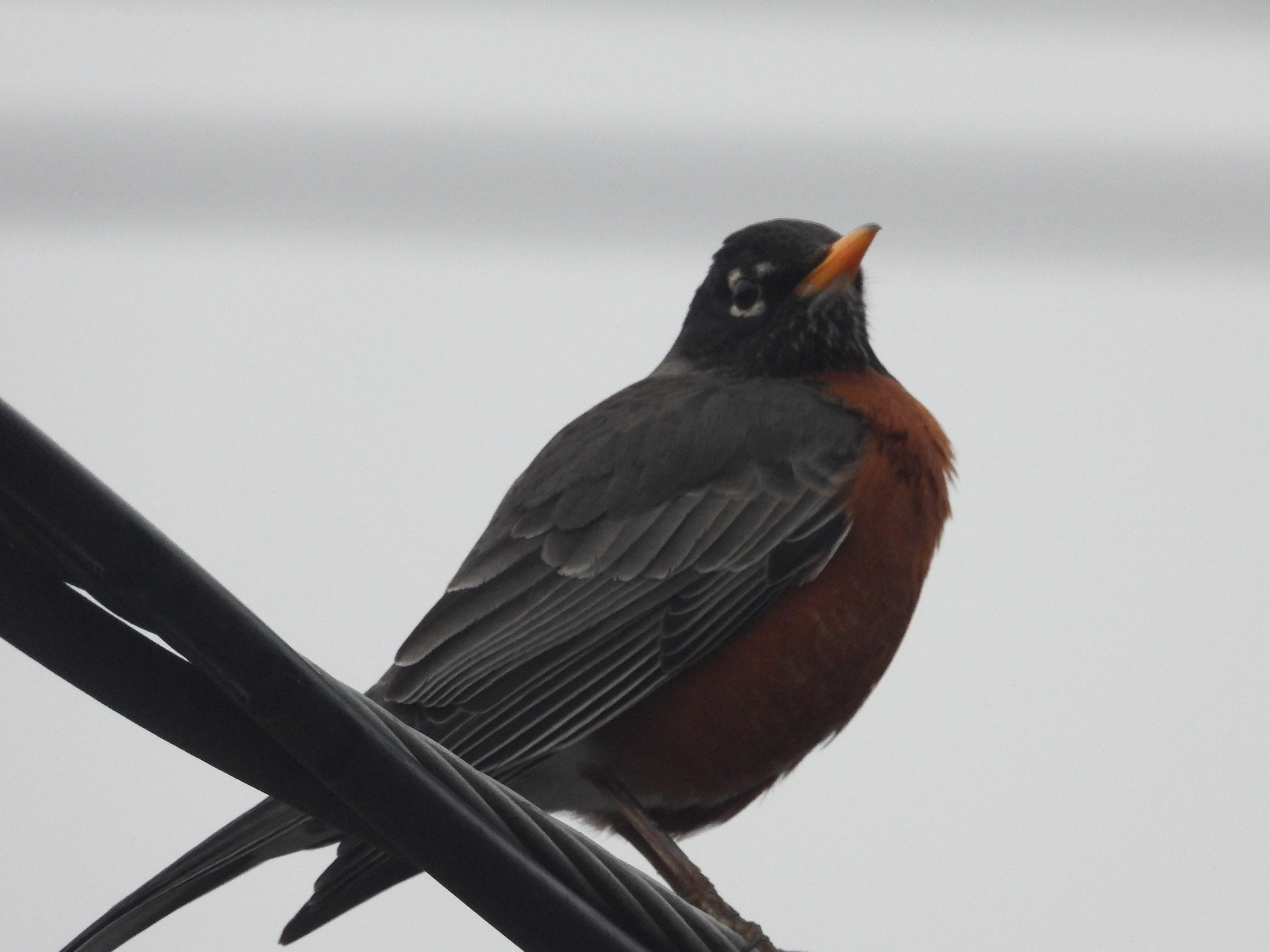
Saturday is a perfect windy balcony dawn, the first non-foggy morning in ages and a relatively balmy 38. Days of rain have already melted away most of the snow, and the river’s high; a snowstorm of unknown proportions is expected for tomorrow. By 6:34, Common Mergansers are already streaming north, and a Red-tailed Hawk is circling over the point of Sapsucker by seven. Starlings rush back in from over the mountain a few minutes later, and then a robin flutters across town. It ends up landing close to the balcony on a wire, calling vociferously, the first move on local territory of 2026.
All we get today is a dull red in the east, enough to backlight a trio of Bald Eagles circling around the comms towers as the wind grows wilder. Two Northern Harriers, a Cooper’s Hawk, and a Red-shouldered Hawk are soon up in the air as well, and the Bald Eagle number grows to at least six. It seems as if the snowmelt and wind are finally making the raptors restless, striking out to search for new and better patches of bare ground after weeks of desperation; who knows? Even a rare winter Merlin courses through town over my head, lost to sight off toward the train station. And then a bigger robin flock, some 19 in all, heading south. The starlings begin to gather in the nearby sycamores by 8 AM, one making that catbird meow.
In the late morning we hike up the mountain. Three Common Grackles fly past at a Sinking Valley overlook—soon, very soon, now, they’ll be on the west side, over by Tyrone. In the night, a pulse of American Tree Sparrows shows up on the antenna around 4 AM, already on the move. Loud crows are also calling in the middle of the dark.
The promised snowstorm fizzles to wet inches that melt quickly away. The turn back to winter is too late to stop the Song Sparrows, who sing through the thickest flakes. House Finches and starlings also can’t be stopped, and the first American Robin song of the season rings out as well.
On Monday the 23rd, the first grackle appears in the skies over Tyrone at 7:13 AM, coming from the south. Ten minutes later, two Black Vultures are circling over the balcony. More days of murk and muck, and by Thursday, it’s finally calm and clear again, and slightly below freezing. Robins and song sparrows are up long before 6 every day now, trying to outcompete each other from multiple points about town. By a quarter to seven, ravens, grackles and starlings are all flying, and a Red-winged Blackbird flock arrives from the east. Robins now land in nearby trees and on the wires, letting out loud peeks and whispery tremolos.
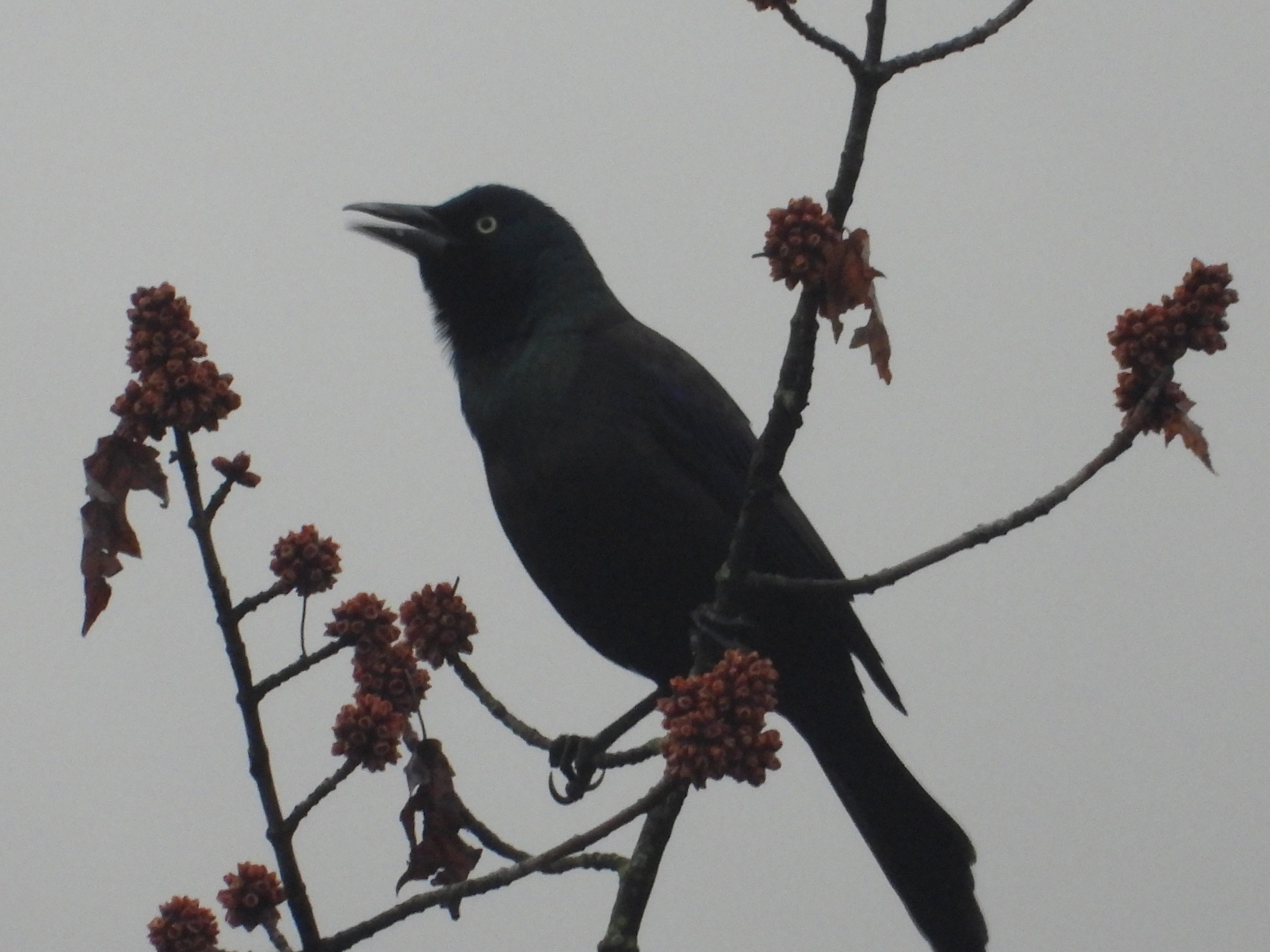
At 7:15 AM, a male grackle alights at the top of the tall sycamore at my 1 PM over by the interstate. Another unstoppable force of 2026.
A warm-up is promised before the end of the month, so it’s highly likely that conditions will be right for the first major northward move of waterfowl, some of which I can snag on the antenna. Sure enough, Friday night sees a major lift-off, with the first Ring-billed Gulls before dusk, and the first-of-year Tundra Swan flock at 9:27 PM. Canada Geese stream over in untold hundreds, some so close that the antenna picks up their grunts and all the other little sounds one rarely hears from the ground. Northern Pintail hees are picked up twice before midnight, along with the wing whistles of many and mostly unidentifiable waterfowl. The first Long-tailed Ducks go over around 10:30 PM, the first Wood Duck screeches, and the first Killdeer all within minutes. And it’s not over yet!
Peents at 12:26 AM are the first definite signs of American Woodcock, right on schedule. These come from migrating birds, but they’ll soon be settling into Sinking Valley fields , and our own fields not long after. A Gadwall is picked up not lnog before 4 AM, and another flock of tree sparrows, while Ring-billed Gulls never cease.
Before dawn on Saturday the 28th, the first day of the third world war, I drive up for the first time in ages on a complete frost-free driveway. Ravens are nesting in the spruce grove, and their eerie moans are now among the first sounds of the day. I catch the tail end of the waterfowl pulse with a quacking Mallard close overhead that I never see. Tree sparrows are singing as half a hundred robins alight in the trees beyond the garage. That night, the waterfowl have another go of it, with more pintails and the unique whi-whee-whew signature of an American Wigeon rounding out the month. March begins with the rapid wings of a Hooded Merganser in the dark somewhere, as the swans go on and on.
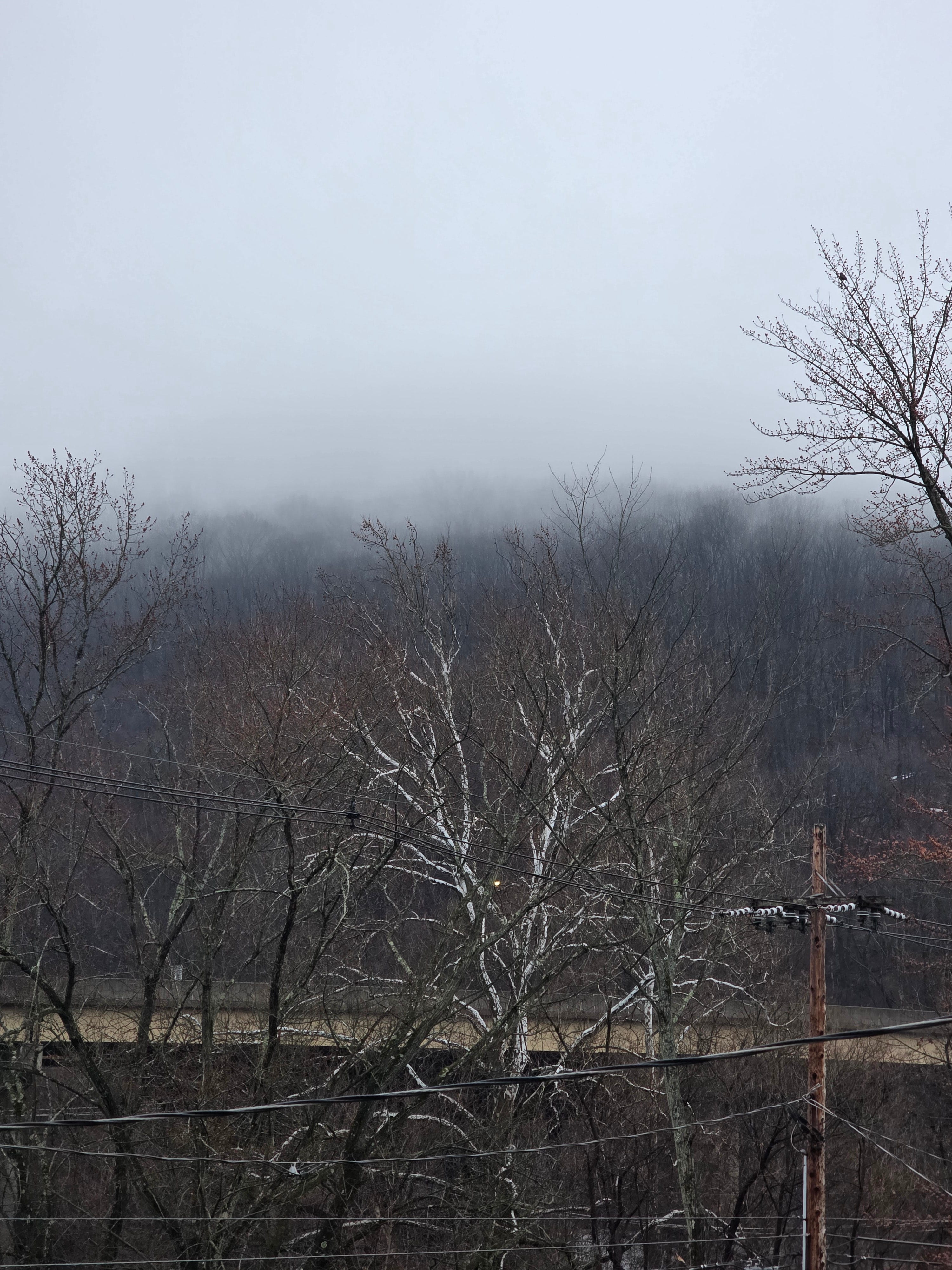
Who’ll stop the rain?
Imperial bombs rain down on an uncomprehending world all through the first week of March, while here, fittingly, a steady rain engulfs us and the migrants are stopped dead in their tracks once again. I manage to snag a pair of high-power binoculars for the next fast movers, just as a rogue bit of Covid lays me out.
The forecast keeps pushing clearing later, which suits me fine as I doomscroll through the dawns. On Friday, a Killdeer cries in the fog above the balcony, and large flocks of grackles and robins settle into the trees all around. Finally, on Saturday the 6th, I head out on foot, hoping that I can top the the thick fog in town. Light-triggered robins and Song Sparrows are everywhere now, and Killdeer are singing incessantly over in the fields by the interstate. The Hollow is dead silent, with ghostly patches of drift the last stubborn remnants of the blizzard.
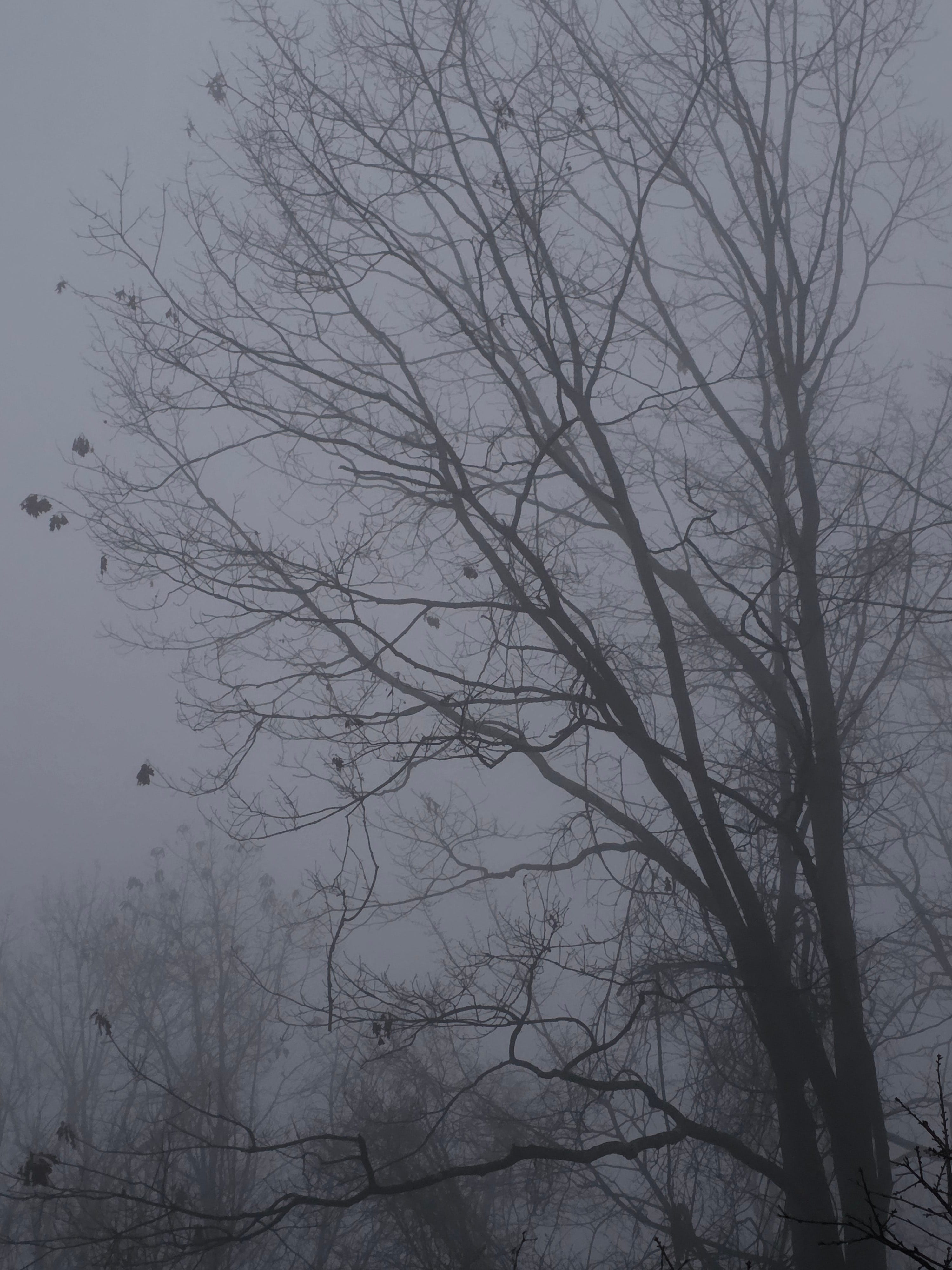
The fog doesn’t abate with the ascent, but instead grows thicker. The powerline at 6 AM is as foggy as I’ve ever seen here, the temperature a not-so-balmy 44. The valley below is free of human noise but alive with the sound of Killdeer and the peents of woodcocks, one of which buzzes up the cut and over my head, going to First Field, I suppose (and as the antenna later proves). A Great Horned Owl hoots on an on, and by 6:10 it’s joined by an Eastern Screech-Owl from another direction. Northern Mockingbirds, robins, and Northern Cardinals wake up in quick succession, and at 6:17 the swelling chorus magnified and distorted by the fog includes the year’s first singing Field Sparrow.
Merlin keeps picking up Fox Sparrow flight calls, but it seems too early for that; they’re probably just Songs. Their wispy calls, oddly enough, are also coming from thick laurel along the trail up the ridge. A bulky shape pops out, and too my amazement, a Fox Sparrow poses in the fog a few feet away. Something interesting is afoot; it’s a bit too far away from the field to hear much other than a distant cacophony of song, and I’ve got to get by the shrieks and moans of the ravens first. At the top of the field, the ravens are all about me, diving through the locusts. I head down the field and am immediately engulfed by a dizzying fallout of Song Sparrows, singing from every goldenrod, just above the tinkling, buzzing pitch of the equally abundant juncos. The bird patch has swallowed up the neck of the field and the adjoining woods, and accounts for that Fox Sparrow outlier in the unlikeliest of places. I suppose that the stagnation is responsible, as the northward migrant flow seems to have been bottled up here for days.
After a respite, I hear new noises coming from above the amphitheater. Robins everywhere, hundreds, flying up from open grass patches into locusts all around me. The lone, tall black walnut also has a group of starlings—a species that rarely flocks into trees up here—as well as an unusually large number of Red-winged Blackbirds. I listen for other sounds—a Hermit Thrush, a Northern Flicker—from what’s mixed into the throng, and something just a bit different squeaks and squeals from the old apple tree. Three Rusty Blackbirds! These are the first I’ve seen up close and perched in many years here; I typically get them only in flight.
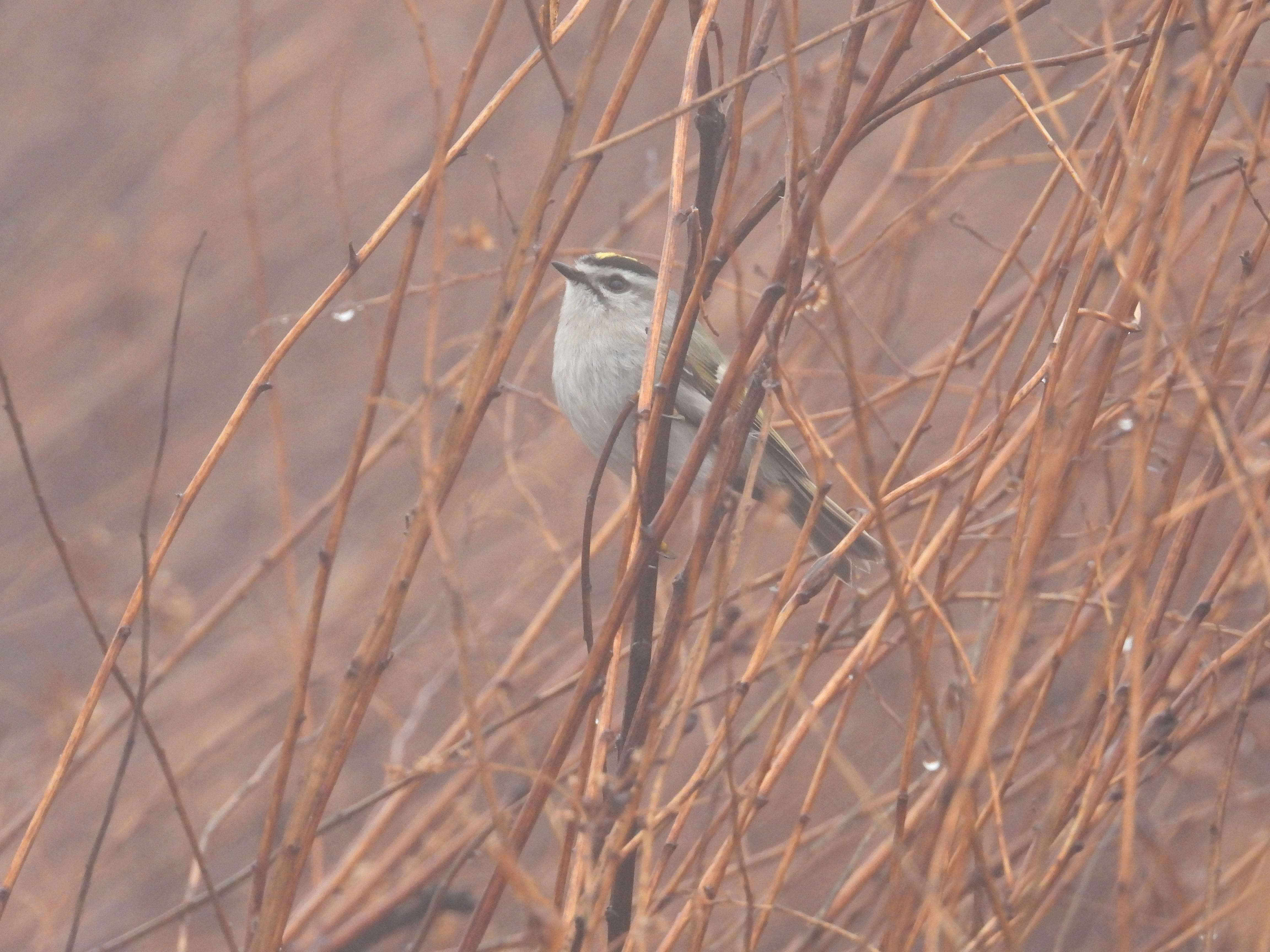
The robins are all over the yard, then the trees, then the field, back and forth, one or multiple flocks. At the height of it a lone Golden-crowned Kinglet flits about the goldenrod among dozens of juncos and stays still long for me to get a decent photo. The spell is broken.
The weather finally breaks in the afternoon and strong storms build up; tomorrow is looking to be a doozy.
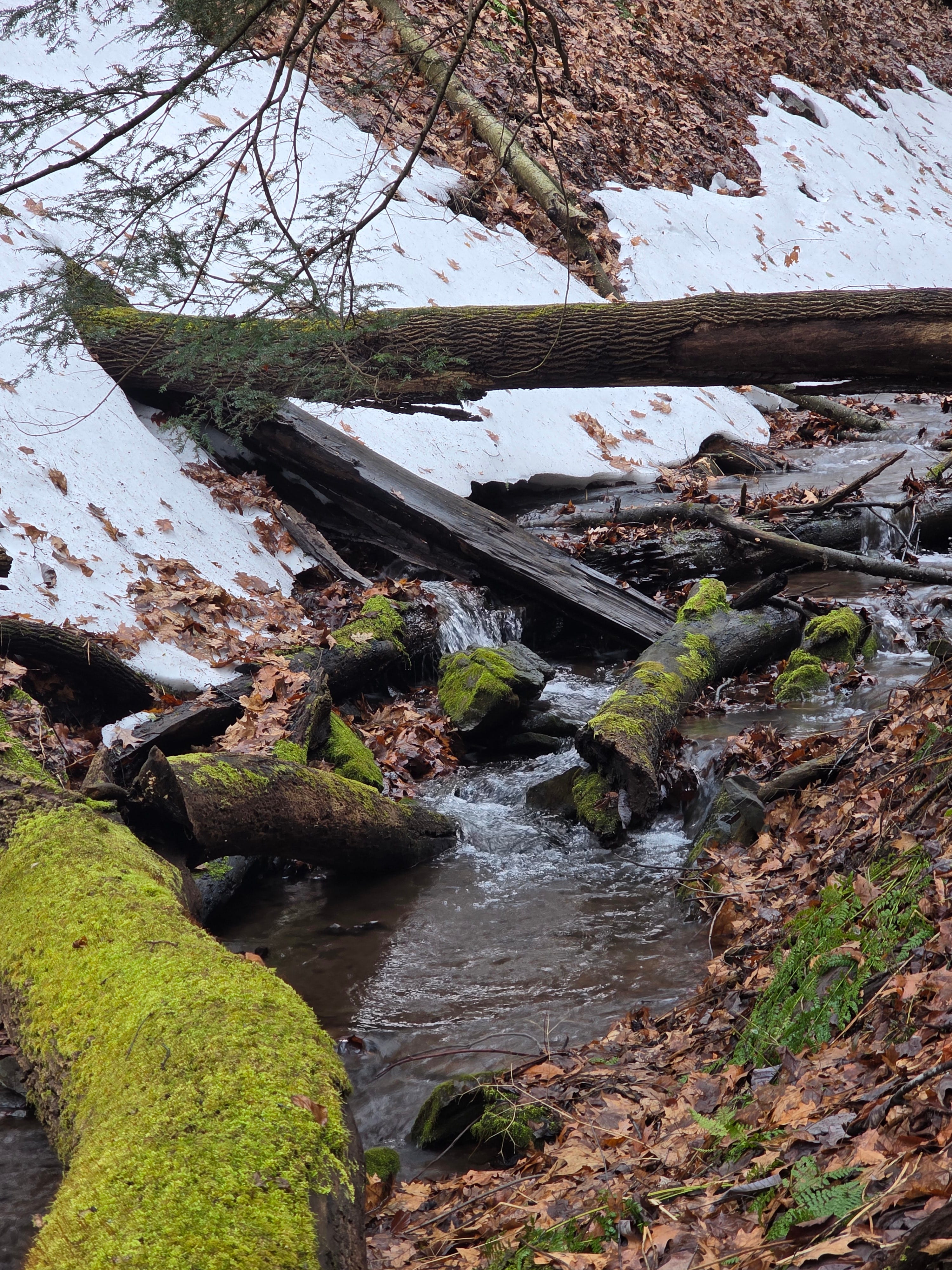
Duck sp.
Though still not a crystal-clear dawn, the clouds are high and there’s a nice breeze. The temperature is 58, somehow, warmer than it’s been since November, at least. The key is the direction the breeze—southwesterly, perfect for another northward push. And right off the bat, a Winter Wren is singing at 7:15 AM by the confluence, oblivious to daylight savings time.
Storm clouds roll in from the west, competing with the light, but the waterfowl still give their best dawn performance ever. I can’t ID half of them, phalanxes of fast-moving ducks in the gloom, but I do spot a group of Northern Shovelers above, and a pair of Wood Ducks against the mountainside, as well as a pair of Red-breasted Mergansers. Canada Geese, mostly by the dozen or less, never stop until 9 AM when I have to quit. Turkey Vultures start even when it’s still almost dark, and Golden Eagles soar past on that straight-and-narrow flight path, one after the other (numbers at the nearby Tussey Mt watch are in the dozens for the day). Overall, an improbable 35 species make an appearance; at one point a somewhat raggedy Pileated Woodpecker bounces low over town, coming from the Gap and heading toward Cemetery Hill, something I see only a handful of times all year.
The next days and nights promise to be even wilder, as temperatures are forecast to scrape 80 degrees before we plunged headlong back into winter.